Enzymes and Antibodies: From Molecular Function to Biotechnology Applications
Understanding Enzymes and Antibodies
Proteins perform a wide range of functions in living organisms, from accelerating chemical reactions to recognizing foreign molecules. Among them, enzymes and antibodies are particularly important because of their ability to interact selectively with specific molecular targets.
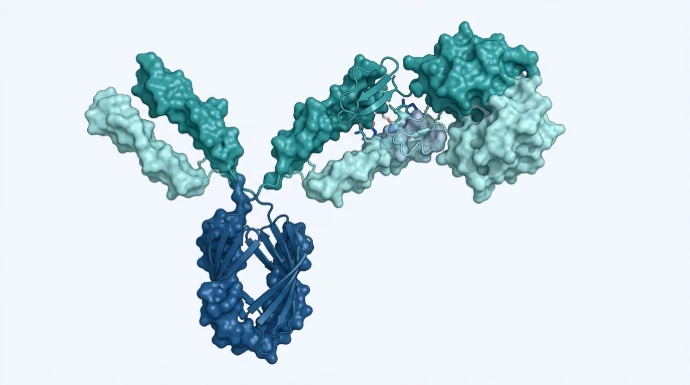
Enzymes act as biological catalysts, accelerating chemical reactions without being consumed by the overall reaction. Antibodies are proteins produced by the immune system that recognize specific molecular structures called antigens. Although they perform different biological roles, both depend on their three-dimensional structures and molecular interactions.
Understanding these proteins provides a foundation for exploring modern biotechnology and the development of new diagnostic and therapeutic tools.
Applications of Enzymes and Antibodies in Biotechnology
Diagnostic Testing
Enzymes and antibodies are frequently combined in diagnostic methods such as enzyme-linked immunosorbent assays (ELISA). In a typical ELISA, an antibody recognizes a target molecule, while an enzyme linked to a detection antibody or another assay component produces a measurable signal.
This signal can be detected through a color change or another suitable measurement, helping researchers determine whether a target is present and, under appropriate conditions, estimate its concentration.
The accuracy of a diagnostic assay depends on factors such as antibody specificity, assay design, calibration, and validation.
Medicine and Therapeutic Research
Antibodies are important tools in modern medicine. Therapeutic antibodies can be designed to bind specific molecular targets involved in diseases, including certain cancers and inflammatory conditions. Their effects depend on the target, antibody properties, and biological context.
Enzymes also contribute to biomedical research and pharmaceutical development. They can serve as research tools, therapeutic agents in selected conditions, or catalysts in the production of pharmaceutical compounds.
Both protein types require careful characterization and testing to establish their activity, safety, and suitability for specific applications.
Industrial Biotechnology
Enzymes enable chemical transformations under conditions that can be milder than those required by some conventional industrial processes. They are used in food processing, detergent formulations, textile production, and the synthesis of useful compounds.
Their selectivity can help reduce unwanted by-products and improve manufacturing efficiency. However, industrial applications often require enzymes with suitable stability, activity, and tolerance to operating conditions.
Researchers use protein engineering, directed evolution, and computational methods to develop enzyme variants that better meet these requirements.
How Enzymes Work
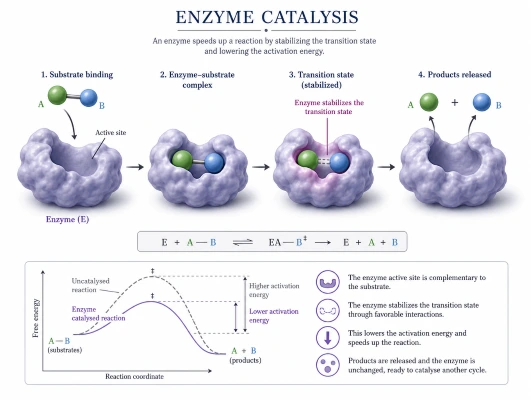
Enzymes accelerate biochemical reactions by interacting with specific molecules known as substrates. The substrate binds to a region of the enzyme called the active site, where molecular interactions facilitate the conversion of substrates into products.
Enzyme activity depends on several factors, including temperature, pH, substrate concentration, and the presence of inhibitors or activators. Changes in these conditions can affect reaction rates, enzyme stability, and overall performance.
Because enzymes can catalyze reactions with high efficiency and selectivity, they are widely used in scientific research, food production, pharmaceutical manufacturing, and industrial biotechnology.
How Antibodies Recognize Molecular Targets
Antibodies are specialized proteins of the adaptive immune system. Their characteristic Y-shaped structure contains variable regions that recognize specific molecular features on antigens. This recognition depends on the complementary shapes and chemical properties of the interacting molecules.
Antibody binding can help the immune system identify pathogens and other foreign substances. In biotechnology, researchers use antibody specificity to develop diagnostic assays, investigate biological processes, and design targeted treatments.
Antibody performance depends on more than binding alone. Affinity, specificity, stability, and interactions with other biological components can all influence their suitability for research or therapeutic applications.